
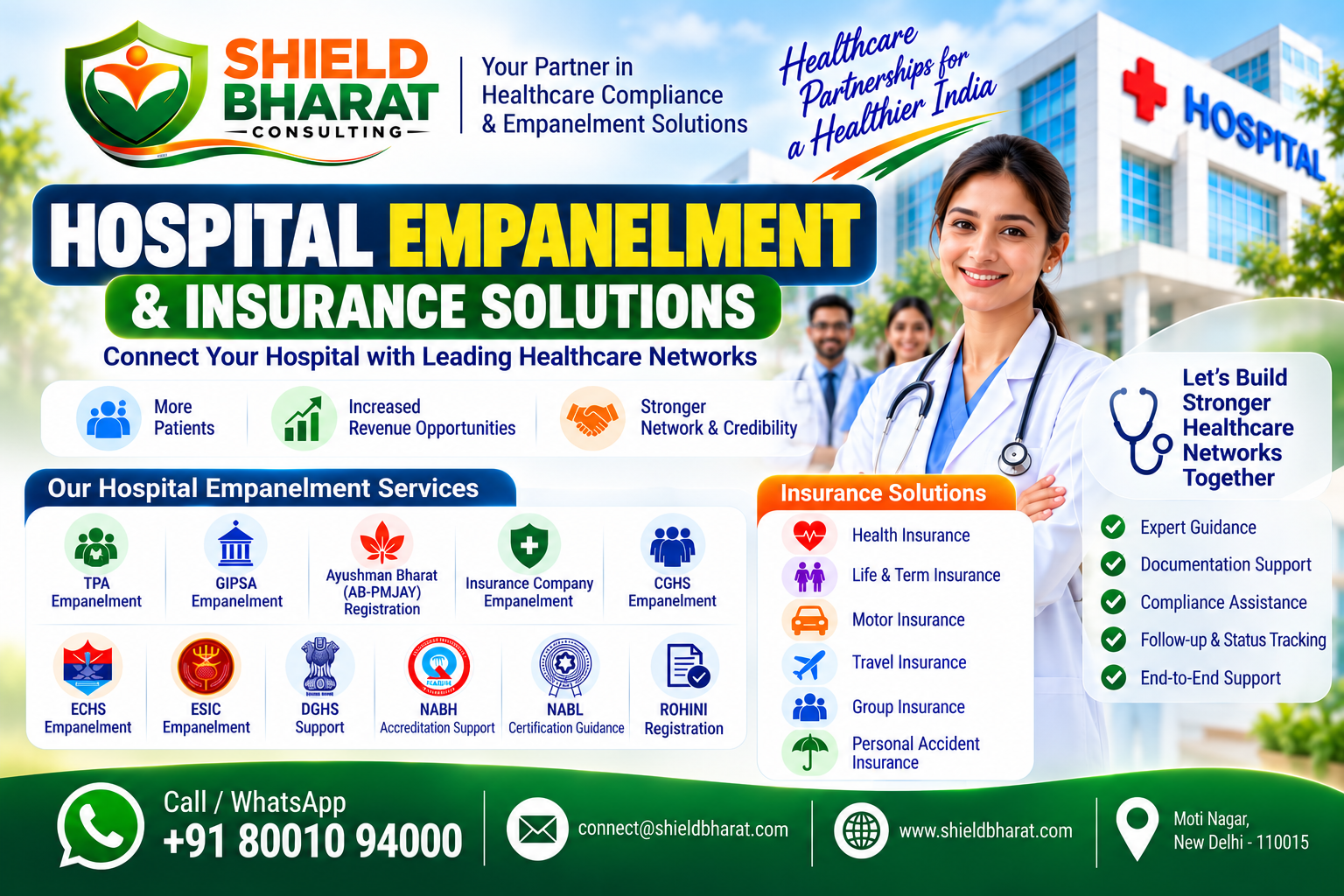
Introduction: Why Hospital Empanelment Matters for Healthcare Providers
Running a hospital today involves much more than providing quality medical treatment. Hospital owners and administrators must also manage patient services, medical documentation, regulatory requirements, financial operations, insurance coordination, and relationships with healthcare networks.
One important part of this process is hospital empanelment.
Hospital empanelment allows an eligible healthcare facility to apply for inclusion in the network of an insurance company, Third-Party Administrator (TPA), government healthcare scheme, or another authorized organization. Depending on the arrangement, an approved hospital may be able to provide covered treatment to eligible patients under applicable insurance or healthcare schemes.
For hospitals, nursing homes, multispecialty facilities, and eligible diagnostic centres, understanding the empanelment process can help identify opportunities to serve patients who rely on insurance and government healthcare benefits.
However, empanelment requirements vary. Each organization may have its own application process, documentation requirements, infrastructure standards, service criteria, and contractual conditions.
This is where professional guidance can be valuable.
Shield Bharat Consulting provides hospital empanelment guidance, documentation assistance, insurance network support, and healthcare compliance-related consultancy to hospitals and healthcare providers across India.
Whether you are establishing a new hospital, managing an existing nursing home, or planning to expand your healthcare services, understanding hospital empanelment is an important step toward building sustainable healthcare operations.
What Is Hospital Empanelment?
Hospital empanelment is the process through which a hospital applies to become an approved healthcare provider within a particular insurance, government healthcare, or institutional network.
The organization reviewing the application evaluates the hospital according to its applicable eligibility criteria and requirements.
These may include:
Valid registrations and statutory licences.
Hospital infrastructure and available facilities.
Qualified doctors, nurses, and supporting staff.
Medical equipment and treatment capabilities.
Specialties and procedures offered.
Medical records and documentation systems.
Quality, safety, and infection-control practices.
Financial, banking, and administrative information.
Applicable accreditation or certification requirements.
The exact requirements depend on the organization and the type of empanelment being requested.
Once an application is approved and the necessary agreement or formalities are completed, the hospital can operate within the scope of the approved arrangement.
It is important to understand that submitting an application does not automatically guarantee approval. The final decision rests with the concerned insurer, TPA, government authority, scheme administrator, or other responsible organization.
Why Is Hospital Empanelment Important?
Hospital empanelment can support a healthcare facility's efforts to connect with relevant patient and payer networks.
When a hospital joins an appropriate network, it may become accessible to eligible patients seeking treatment through insurance or a particular healthcare scheme.
The potential advantages depend on the hospital's location, specialties, network agreement, operational capacity, and local demand.
1. Access to a Wider Patient Network
Patients increasingly consider insurance coverage and network availability when selecting a healthcare provider.
An approved network relationship may help eligible patients identify a hospital where their policy or healthcare scheme can be used, subject to applicable conditions.
For hospitals, this can create opportunities to serve patients who might otherwise choose another provider.
2. Support for Cashless Treatment Arrangements
Under an applicable cashless arrangement, eligible treatment expenses may be settled directly between the insurer or its authorized administrator and the hospital, subject to policy conditions, pre-authorization requirements, exclusions, and agreed procedures.
Cashless treatment is not automatically available for every patient or every medical procedure.
Hospitals must verify eligibility, coverage, authorization, and the applicable agreement before proceeding under an insurance arrangement.
3. Opportunities to Develop Healthcare Networks
Empanelment can help hospitals establish formal relationships with insurance companies, TPAs, government healthcare schemes, and institutional healthcare programmes.
These relationships may support the hospital's long-term network development strategy.
4. Improved Administrative Processes
A structured empanelment process encourages hospitals to organize important records, licences, staff credentials, service information, and administrative procedures.
Better documentation can also support day-to-day hospital management and future applications.
5. Opportunities for Institutional Development
Hospitals that review their infrastructure, staffing, service capabilities, and compliance processes may identify areas for improvement.
These improvements can support operational readiness, although empanelment alone does not guarantee increased revenue, patient volume, or business growth.
Types of Hospital Empanelment Services in India
Hospitals may explore several types of empanelment depending on their eligibility, services, and business objectives.
1. TPA Empanelment Services
A Third-Party Administrator, commonly known as a TPA, provides specified administrative services related to health insurance under the applicable regulatory framework and arrangements with insurers.
Hospitals seeking to participate in insurance networks may need to apply to relevant insurers or follow the applicable TPA-supported process.
TPA-related hospital empanelment assistance may include:
Identifying relevant application requirements.
Preparing hospital information and supporting documents.
Organizing licences and registration records.
Reviewing specialty and infrastructure information.
Coordinating application submission.
Responding to document queries.
Following up on application status.
Reviewing applicable agreement and operational requirements.
The process varies between organizations. Some insurers manage network applications directly, while others use TPAs or designated service arrangements.
Professional consultancy can help hospitals organize their applications and understand the required steps.
2. GIC and GIPSA Empanelment Support
Hospitals may also explore relevant general insurance and GIPSA-related panel arrangements.
GIPSA stands for General Insurance Public Sector Association. Its relevance depends on the specific panel, participating organizations, and applicable arrangements.
The hospital should confirm the current eligibility criteria, application route, documentation requirements, and commercial conditions for the particular network it wishes to join.
Support may include application preparation, document coordination, requirement reviews, and follow-up assistance.
Hospitals should not assume that one application automatically provides access to every insurer or panel.
3. Ayushman Bharat PM-JAY Hospital Empanelment
Ayushman Bharat Pradhan Mantri Jan Arogya Yojana (AB-PMJAY) is a government health assurance scheme implemented through the applicable national and state-level framework.
Eligible hospitals can explore empanelment under the scheme if they meet the relevant requirements.
The application process may involve verification of hospital details, infrastructure, specialties, staff, facilities, and other scheme-specific criteria.
Private hospitals should review the latest guidelines issued by the National Health Authority and the relevant State Health Agency before applying.
Requirements and procedures may change, so hospitals should use current official guidance rather than relying exclusively on older checklists.
4. CGHS Empanelment Support
The Central Government Health Scheme (CGHS) provides healthcare services to eligible beneficiary groups under its applicable rules.
Hospitals interested in CGHS-related empanelment should review the current requirements, applicable city or service arrangements, and relevant application procedures.
Depending on the current process, hospitals may need to provide information about infrastructure, specialties, facilities, rates, and other eligibility requirements.
Professional assistance can help organize the required documentation and coordinate application-related tasks.
5. ECHS Empanelment Support
The Ex-Servicemen Contributory Health Scheme (ECHS) provides healthcare benefits to eligible beneficiaries under its rules.
Hospitals seeking ECHS empanelment should verify the current application process, service requirements, documentation standards, and applicable contractual conditions.
Support may include document preparation, application coordination, and follow-up assistance.
6. ESIC Empanelment Support
The Employees' State Insurance Corporation (ESIC) operates within India's employee social security framework.
Eligible healthcare providers may explore relevant ESIC-related empanelment opportunities according to the applicable requirements and arrangements.
Hospitals should check the current criteria for their location, specialties, services, and intended participation.
7. DGHS and Other Institutional Empanelment
Hospitals may also explore applicable arrangements involving the Directorate General of Health Services (DGHS), government departments, public-sector institutions, or other authorized healthcare programmes.
Eligibility and procedures differ by programme.
Before beginning an application, hospitals should identify the correct authority, verify current requirements, and determine whether their services and facilities meet the applicable criteria.
Hospital Accreditation and Registration Support
Empanelment is not the only administrative requirement hospitals may need to address. Depending on the organization and programme, registration, quality certification, or accreditation may also be relevant.
NABH Accreditation and Pre-NABH Support
The National Accreditation Board for Hospitals & Healthcare Providers (NABH) operates within the Quality Council of India framework.
NABH accreditation relates to defined healthcare quality and patient-safety standards.
Hospitals preparing for accreditation may need to review policies, standard operating procedures, patient records, staff training, infection control, medication management, facility safety, and other applicable requirements.
Pre-NABH or entry-level programmes may be relevant to certain facilities, subject to the current programme criteria.
Consultancy support may include readiness assessments, documentation guidance, internal process reviews, and preparation for assessment.
Accreditation is awarded by the authorized body according to its requirements; consultancy does not guarantee accreditation.
NABL Certification and Accreditation Guidance
The National Accreditation Board for Testing and Calibration Laboratories (NABL) provides accreditation-related services for eligible laboratories and other conformity assessment bodies under applicable schemes.
Diagnostic laboratories should confirm the correct programme, scope, technical requirements, and assessment process before applying.
Preparation may involve reviewing quality management systems, technical procedures, equipment records, staff competency, quality-control documentation, and other relevant requirements.
The scope of accreditation depends on the approved application and assessment outcome.
ROHINI Registration
The Registry of Hospitals in Network of Insurance (ROHINI) is associated with hospital identification and information in the health insurance ecosystem.
Hospitals should verify current registration requirements, the appropriate application route, and the information required for their facility.
Registration and empanelment are not necessarily the same thing. Completing one process does not automatically establish approval under every insurer or healthcare scheme.
Documents Commonly Required for Hospital Empanelment
The exact checklist depends on the target organization and application category. Hospitals should obtain the latest official checklist before preparing their application.
The following documents and records may be requested.
Hospital Registration and Legal Documents
Hospital or establishment registration.
Applicable statutory licences and permissions.
Ownership, partnership, company, or trust documents.
PAN and applicable tax registration details.
Authorized signatory information.
Bank account and supporting banking documents.
Infrastructure and Facility Information
Hospital address and contact information.
Number of beds and available facilities.
Specialty-wise service details.
Medical equipment information.
Facility photographs or inspection-related records, where required.
Fire safety and other applicable compliance records.
Medical and Administrative Records
Doctor qualifications and registration details.
Nursing and supporting staff information.
Duty schedules or staffing records, where requested.
Infection-control policies.
Emergency and patient-safety procedures.
Medical record management processes.
Applicable quality policies and standard operating procedures.
Financial and Operational Information
Tariff details, where required.
Billing and claims contact information.
Hospital administrator and nodal officer details.
Applicable agreements or declarations.
Additional records requested by the insurer, TPA, or authority.
This is a general preparation checklist, not a universal list of mandatory documents. Hospitals should submit only accurate, valid, and appropriately authorized information.
The Hospital Empanelment Process: Step by Step
A planned approach can make the application process more organized.
Step 1: Identify the Right Empanelment Opportunity
Determine which insurer, TPA, government scheme, or institutional network is relevant to your hospital.
Consider your specialties, location, facilities, target patient groups, and operational capacity.
Step 2: Review Eligibility Requirements
Study the current eligibility criteria and application instructions issued by the concerned organization.
Check whether your hospital meets the requirements before investing time in the application.
Step 3: Conduct a Documentation Review
Collect relevant licences, registrations, staff credentials, infrastructure information, and supporting records.
Identify missing, expired, inconsistent, or outdated information.
Step 4: Review Infrastructure and Compliance Readiness
Compare your hospital's current arrangements with the applicable standards.
Address genuine gaps in documentation, facilities, staffing, safety procedures, or quality systems.
Step 5: Prepare and Submit the Application
Complete the relevant application accurately and provide the requested supporting documents.
Maintain copies of submitted records, acknowledgement details, and correspondence.
Step 6: Respond to Queries and Verification Requests
The reviewing organization may request additional information, clarification, or a facility assessment.
Respond within the stated timelines and ensure that the information provided is consistent with the hospital's actual operations.
Step 7: Review Approval and Contractual Conditions
If approved, carefully review the applicable agreement, rates, service scope, authorization requirements, billing procedures, claims documentation, and other obligations.
Ensure that the relevant hospital staff understand the approved arrangement.
Step 8: Maintain Compliance After Empanelment
Empanelment is not necessarily a one-time administrative exercise.
Hospitals may need to maintain valid licences, update records, follow agreed procedures, respond to audits, and comply with renewal or review requirements.
A designated team member can help monitor these responsibilities.
Common Hospital Empanelment Challenges
Many hospitals encounter administrative difficulties during the application process. Understanding these issues can help prevent avoidable delays.
Incomplete Documentation
Missing licences, outdated registrations, inconsistent addresses, or incomplete staff records may lead to queries.
A checklist-based review before submission can help identify these problems.
Incorrect Application Information
Information that differs across forms, licences, and supporting documents can create verification issues.
Hospitals should check names, addresses, registration numbers, specialty details, and authorized signatory information carefully.
Infrastructure or Eligibility Gaps
A hospital may not meet every requirement of the target programme.
It is better to identify such gaps early and determine whether they can be addressed than to assume that an application will be approved.
Poor Follow-Up
Unanswered queries or missed deadlines can affect application progress.
Hospitals should maintain a record of submissions, communications, pending documents, and next actions.
Limited Understanding of Contractual Requirements
Approval is only one part of the process.
Hospitals should understand the agreement's payment terms, documentation standards, pre-authorization process, claim submission requirements, and applicable service obligations before beginning operations under a new arrangement.
How Shield Bharat Consulting Supports Hospitals
Shield Bharat Consulting assists hospitals, nursing homes, clinics, and eligible healthcare providers with empanelment-related guidance and healthcare compliance support.
Our approach focuses on helping healthcare organizations understand requirements, prepare documentation, and coordinate application-related activities.
Our services may include:
TPA empanelment guidance.
Insurance company empanelment support.
GIC and GIPSA panel guidance.
AB-PMJAY application support.
CGHS, ECHS, ESIC, and DGHS-related assistance.
NABH and Pre-NABH preparation support.
NABL accreditation guidance.
ROHINI registration assistance.
Documentation and application coordination.
Follow-up and status tracking.
Guidance on applicable compliance requirements.
Every hospital has different requirements. The appropriate scope of support depends on the facility, target organization, available documentation, and applicable criteria.
We encourage hospitals to discuss their objectives before beginning an engagement so that the relevant requirements and expected work can be identified.
Shield Bharat Consulting operates as an independent consultancy. Final empanelment, registration, and accreditation decisions remain with the respective insurers, TPAs, government authorities, or authorized accreditation bodies.
Hospital Empanelment Services in Delhi NCR and Across India
Hospitals often search for empanelment consultants who understand the administrative requirements relevant to their location and target networks.
Shield Bharat Consulting is based in Moti Nagar, New Delhi, and provides consultancy support for hospital empanelment and related healthcare requirements.
Hospitals in Delhi, Noida, Ghaziabad, Gurugram, Faridabad, and other parts of the National Capital Region may explore support based on their specific requirements.
Healthcare providers in other Indian states can also discuss their empanelment objectives and determine the appropriate application process.
Location alone does not determine eligibility. Requirements depend on the particular insurer, scheme, authority, hospital category, and services offered.
Whether you manage a small nursing home, a multispecialty hospital, or an eligible diagnostic facility, begin by identifying the networks relevant to your services and reviewing their current requirements.
Frequently Asked Questions About Hospital Empanelment
1. What is hospital empanelment?
Hospital empanelment is the process of applying to join an approved healthcare network operated by an insurer, TPA, government scheme, or other authorized organization. Approval depends on the applicable eligibility criteria and review process.
2. How can a hospital apply for TPA empanelment?
A hospital should identify the relevant insurer or TPA-related application route, review its eligibility criteria, prepare the required documents, submit the application, and respond to any verification requests or queries.
3. What documents are required for hospital empanelment?
Requirements vary, but may include hospital registration, statutory licences, ownership documents, staff credentials, infrastructure details, bank information, specialty details, and relevant quality or compliance records. Always check the latest official checklist.
4. Can a small hospital or nursing home apply for empanelment?
Potentially, yes. Eligibility depends on the particular network's requirements, including facility standards, staffing, specialties, location, and other criteria. Smaller facilities should check the specific requirements before applying.
5. Is NABH accreditation mandatory for every hospital empanelment?
No universal rule applies to every insurer, TPA, or healthcare scheme. Some programmes may require particular accreditation or certification, while others may have different eligibility standards. Check the current criteria for the intended network.
6. Does TPA empanelment guarantee cashless treatment for every patient?
No. Cashless treatment depends on the applicable network agreement, patient eligibility, policy coverage, authorization, and other conditions. Hospitals should verify these details for each case.
7. How long does hospital empanelment take?
There is no single timeline for all applications. Processing time depends on the reviewing organization, completeness of the application, verification requirements, queries, and other factors. Ask the concerned organization for its current process and expected timelines.
8. Can a hospital apply to multiple insurance companies?
A hospital may explore applications to multiple insurers or networks, provided it meets the respective eligibility criteria and can comply with each agreement. Each application should be evaluated independently.
9. What does a hospital empanelment consultant do?
A consultant may assist with requirement reviews, document preparation, application coordination, compliance guidance, and follow-up. The consultant does not replace the reviewing authority or guarantee approval.
10. Does Shield Bharat Consulting provide hospital empanelment support outside Delhi?
Hospitals can contact Shield Bharat Consulting to discuss their location, services, and requirements and confirm the available scope of support.
Conclusion: Take a Structured Approach to Hospital Empanelment
Hospital empanelment can be an important part of a healthcare provider's network development strategy. It can help eligible hospitals explore relationships with insurance companies, TPAs, government healthcare schemes, and institutional networks.
The process requires careful planning, accurate documentation, an understanding of eligibility criteria, and attention to the obligations associated with each arrangement.
Rather than applying without a clear plan, hospitals should identify relevant networks, review current requirements, assess readiness, and prepare their applications systematically.
If your hospital needs assistance understanding TPA empanelment, GIPSA-related panels, government healthcare schemes, accreditation preparation, or registration requirements, professional guidance may help organize the process.
Shield Bharat Consulting supports healthcare providers with empanelment guidance, documentation assistance, application coordination, and healthcare compliance-related consultancy.
Contact us to discuss your hospital's requirements and determine the appropriate next steps.
Contact Shield Bharat Consulting
Phone / WhatsApp: +91 80010 94000
Email: connect@shieldbharat.com
Website: shieldbharat.com
Location: Moti Nagar, New Delhi – 110015
Shield Bharat Consulting — Your Partner in Healthcare Compliance & Empanelment Solutions.
Disclaimer: This article provides general informational guidance and is not a substitute for official instructions, legal advice, or professional regulatory advice. Requirements may change and differ by organization, location, specialty, and facility type. Confirm current criteria with the relevant authority. Empanelment, registration, and accreditation approvals are not guaranteed.