
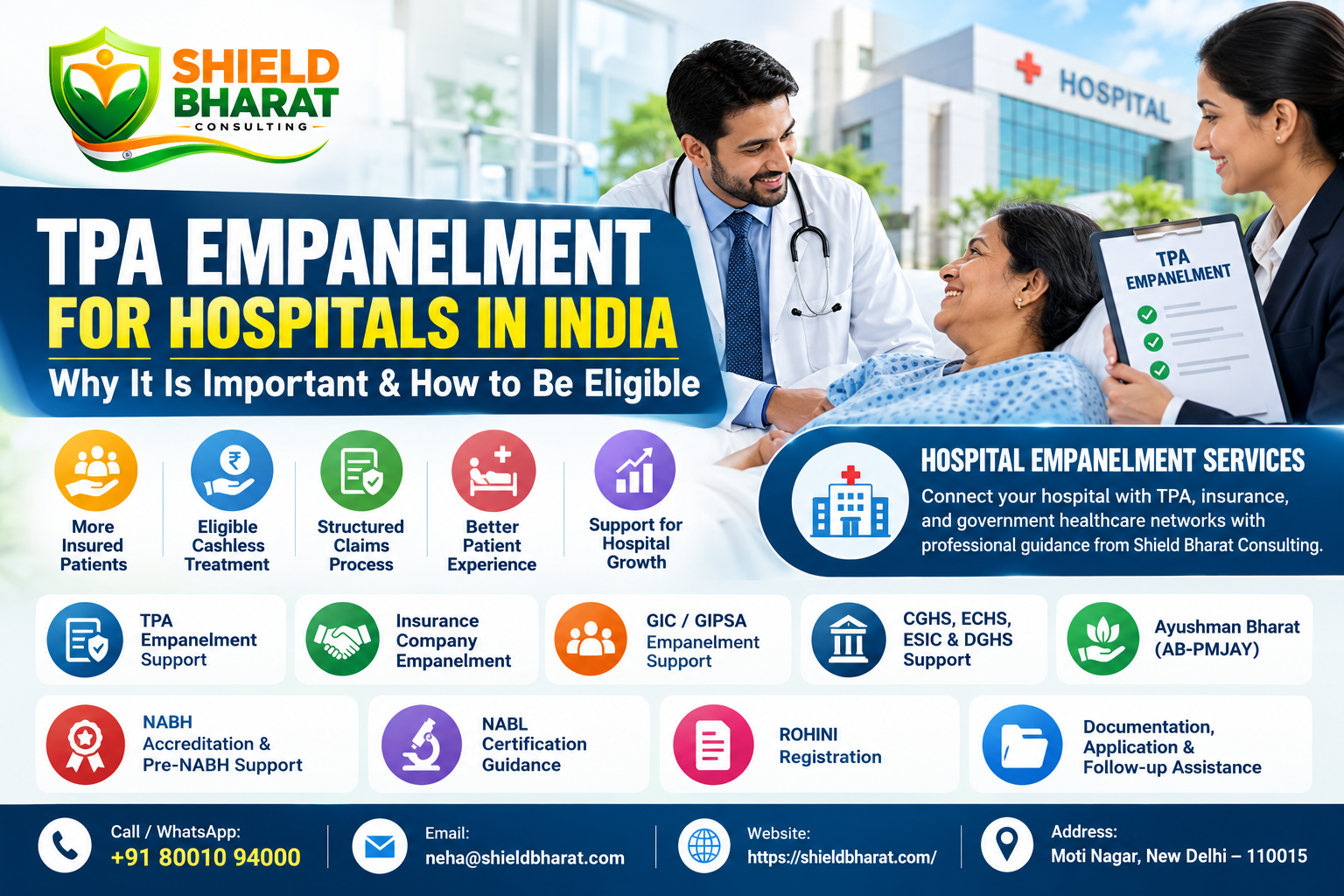
Introduction: Why TPA Empanelment Matters for Hospitals
Running a hospital is about much more than providing medical treatment. Hospital owners and administrators must manage patient care, medical staff, infrastructure, regulatory compliance, operational expenses, billing, documentation, and financial sustainability. At the same time, patients increasingly want convenient access to health insurance benefits and cashless treatment wherever their policy and the hospital's network arrangements permit it.
This is where TPA empanelment for hospitals becomes important.
Imagine a patient who needs surgery and has a valid health insurance policy. The patient may prefer a hospital where an eligible cashless facility is available, rather than paying the entire treatment bill upfront and subsequently applying for reimbursement. If your hospital is part of the relevant insurer's network, it may be able to provide cashless treatment subject to policy terms, pre-authorisation, and approval.
However, if your hospital is not empanelled with the relevant insurer or its applicable network, that cashless option may not be available there.
For hospitals, this can mean a missed opportunity to serve insured patients. For patients, it may mean additional financial arrangements during an already stressful time.
TPA empanelment helps hospitals become eligible for inclusion in applicable health insurance networks and supports a more organised process for insured patient services. The precise arrangement depends on the insurer, TPA, hospital, and applicable agreement. The Insurance Regulatory and Development Authority of India (IRDAI) explains the role of TPAs and network providers in its health insurance guidance. See the official IRDAI health insurance information.
At Shield Bharat Consulting, we help hospitals understand the empanelment process, organise documentation, prepare applications, and manage follow-ups for relevant healthcare networks.
In this guide, we explain why TPA empanelment matters, who may be eligible, what documents hospitals may need, how the application process generally works, and how to prepare your facility for the next step.
1. What Is TPA Empanelment for Hospitals?
TPA stands for Third Party Administrator. In health insurance, a TPA is an entity registered with the insurance regulator and engaged by an insurer to provide specified health services under the applicable arrangement.
These services can include claim-related administration, coordination for cashless treatment, and support for insured members.
Hospital empanelment refers to the process through which a hospital is assessed and enlisted by an insurer, a TPA, or both, as applicable, to provide services to eligible insured patients under agreed conditions.
Once an arrangement is approved and activated, the hospital may be included in the relevant network. Patients can then check whether their policy, treatment, and hospital are covered under the applicable cashless arrangement.
It is important to understand that TPA empanelment is not the same as obtaining a licence to operate a hospital. Nor does one TPA agreement automatically provide access to every insurance company.
Each network has its own application requirements, service expectations, documentation standards, commercial terms, and approval procedures.
In simple words: TPA empanelment helps a hospital participate in an applicable health insurance network so it can provide eligible insured patients with services under the agreed cashless and claims arrangements.
2. Why Is TPA Empanelment Important for Hospitals?
A. Access to insured patients
Patients often consider their insurance coverage when choosing a hospital. If a hospital is included in a network relevant to their policy, it may become a suitable option for insured patients seeking treatment.
For a hospital, this can create opportunities to serve a broader patient base.
However, empanelment does not guarantee patient referrals or a fixed number of admissions. Actual patient volumes depend on location, specialities, clinical reputation, insurer networks, pricing, and patient preferences.
B. Support for eligible cashless treatment
One of the major advantages of network participation is the possibility of offering cashless treatment to eligible insured patients.
Under the applicable arrangement, the hospital submits the required pre-authorisation information, receives a decision, provides approved treatment, and submits the relevant bills and supporting records.
The insurer or its authorised administrator processes the case according to the applicable policy and agreement.
Cashless treatment is subject to eligibility, policy conditions, authorisation, approved treatment costs, and other applicable requirements. It is not an unconditional promise that every treatment expense will be paid.
C. A more structured billing and claims process
Insurance-related hospital billing requires accuracy, supporting clinical records, correct coding where applicable, and compliance with agreed tariffs and documentation requirements.
An established empanelment process encourages hospitals to create clear procedures for:
Patient insurance verification.
Pre-authorisation requests.
Treatment updates and extensions, where required.
Discharge documentation.
Final bill preparation.
Claim submission and query resolution.
Reconciliation of payments and deductions.
A well-managed workflow can reduce avoidable documentation errors and make claim follow-up more systematic.
D. Better patient experience
Medical emergencies and hospital admissions can create anxiety for patients and their families. Confusion about insurance documents, approval status, and billing adds unnecessary pressure.
When hospital staff understand the applicable insurance procedures, they can explain requirements more clearly and help patients navigate the process.
This does not eliminate every delay or rejection, but it can improve communication and reduce preventable misunderstandings.
E. Opportunities to strengthen hospital operations
Empanelment preparation often highlights weaknesses in administrative systems. For example, a hospital may discover that its registration documents are inconsistent, its tariff list needs updating, or its insurance desk lacks a clear claim-tracking process.
Correcting these gaps can improve internal management beyond insurance billing alone.
F. Stronger professional relationships
Hospitals that maintain accurate records, respond to queries on time, follow agreed tariffs, and provide appropriate clinical documentation can build more dependable working relationships with network administrators.
These relationships are not automatic. They require ongoing compliance, service quality, and effective communication.
G. Support for planned growth
A hospital seeking to expand its reach may evaluate private insurance networks alongside government healthcare schemes, corporate health arrangements, and other relevant opportunities.
The right network strategy depends on the hospital's speciality, location, infrastructure, capacity, financial model, and patient population.
For example, a multi-speciality hospital in Delhi NCR may evaluate different networks from a small nursing home in a district town. Applying selectively can be more useful than submitting applications indiscriminately.
3. Who Is Eligible for TPA Empanelment?
There is no single eligibility formula that applies to every insurer and healthcare network. The applicable criteria depend on the organisation receiving the application and the services the hospital intends to provide.
Nevertheless, hospitals can begin by reviewing the following areas.
1. Valid legal establishment and registration
The hospital should have the registrations, licences, and permissions required for its establishment and operations under the laws applicable to its location and facility type.
Depending on the jurisdiction, these may include clinical establishment registration or other applicable healthcare facility permissions.
The hospital's legal name, operating address, ownership details, and registration information should be consistent across its documents.
2. Appropriate infrastructure
The facility should meet the physical infrastructure requirements applicable to its category and proposed services.
These may include patient care areas, consultation rooms, wards, operation theatres, intensive care facilities, diagnostic infrastructure, sanitation arrangements, and other facilities relevant to its specialities.
A small speciality hospital should not assume it must have the same infrastructure as a large multi-speciality facility. Requirements must be checked against the specific network's criteria.
3. Qualified medical professionals
Hospitals should maintain evidence of the qualifications, registrations, appointments, and professional credentials of their doctors and other relevant healthcare personnel.
The availability of specialists, nurses, technicians, and support staff should match the services the facility claims to provide.
4. Appropriate medical equipment
The hospital should have the equipment required for its declared specialities and services. Maintenance, calibration, safety checks, and service records may be relevant where applicable.
5. Emergency and patient safety arrangements
Depending on the hospital category and network standards, reviewers may assess emergency response arrangements, patient safety procedures, infection control, biomedical waste management, fire safety, and other operational safeguards.
Hospitals should maintain applicable permissions and documented procedures rather than treating these requirements as paperwork alone.
6. Transparent billing and tariff structure
Insurance networks may evaluate the hospital's tariff structure, proposed rates, treatment packages, and billing practices.
The hospital should understand the commercial terms before accepting them, including applicable package rates, exclusions, billing rules, and claim-submission timelines.
7. Administrative and claims-handling capability
A hospital should be prepared to manage insurance verification, pre-authorisation, patient records, discharge summaries, bills, queries, and claim tracking.
A dedicated insurance desk can be useful, particularly for hospitals handling multiple network arrangements.
8. Quality and accreditation requirements, where applicable
Some insurers, networks, or schemes may require particular quality certifications, accreditation, or compliance standards for specific categories of facility or service.
NABH accreditation may strengthen a hospital's quality-management framework and may be required or relevant under certain arrangements. It should not be assumed that NABH accreditation is universally mandatory for every private TPA network.
The practical rule: Before applying, compare your hospital's current status with the written eligibility criteria of each intended insurer, TPA, or scheme.
4. Documents Required for TPA Empanelment
Documentation is one of the most important parts of the application process. Incomplete records, inconsistent details, expired permissions, or unclear facility information can lead to queries and delays.
The following is a general preparation checklist. It is not a universal or exhaustive list.
A. Legal and establishment documents
Hospital registration certificate.
Applicable operating licences and permissions.
Ownership, partnership, company, or trust documents, as relevant.
PAN and applicable tax registration details.
Address proof and facility details.
Bank account and cancelled cheque or other bank verification documents.
Authorised signatory details.
B. Medical and staffing documents
Doctor and specialist qualifications.
Relevant professional registration details.
Staff lists and duty rosters.
Nursing and technical staff details.
Speciality-wise service information.
Equipment lists and maintenance records, where requested.
C. Infrastructure and safety documents
Hospital floor plan or layout, if required.
Bed strength and category-wise capacity.
Operation theatre and ICU details, where applicable.
Fire safety permissions or certificates, as applicable.
Biomedical waste management authorisation and records, where required.
Other applicable statutory compliance records.
D. Financial and operational information
Hospital tariff list.
Speciality-wise procedure and package rates.
Billing formats and relevant policies.
Bank details for eligible claim settlements.
Previous claims or operational data, if requested.
Details of insurance coordination staff.
E. Quality and supporting records
NABH accreditation certificate, if obtained or required.
Pre-NABH quality documentation, where relevant.
Infection control policies and patient safety procedures.
Standard operating procedures.
Additional declarations or forms prescribed by the network.
Do not submit every document simply because it appears on a generic internet checklist. First obtain the current requirements of the intended network, then prepare a document set matching those requirements.
Shield Bharat Consulting can assist hospitals with documentation review, application preparation, and follow-up coordination for applicable empanelment opportunities.
5. Step-by-Step TPA Empanelment Process in India
Although individual networks follow different procedures, the general process can be understood in the following stages.
Step 1: Assess the hospital's current status
Begin by reviewing your registrations, licences, infrastructure, medical staffing, service capabilities, tariffs, and administrative systems.
Identify missing documents, expired permissions, inconsistencies, and operational gaps.
This initial assessment helps determine which networks are realistic targets.
Step 2: Identify suitable TPAs and insurance companies
Not every network is equally relevant to every hospital.
Consider the facility's location, specialities, patient profile, expected commercial terms, and the networks that serve its intended patient base.
Prepare a shortlist rather than approaching every organisation without a plan.
Step 3: Obtain the applicable application requirements
Contact the relevant insurer or TPA through its official channel to determine whether it is accepting applications and what requirements apply to your hospital category.
Confirm the prescribed forms, required registrations, tariff expectations, supporting documents, inspection procedures, and submission method.
Step 4: Prepare the application and supporting documents
Complete the forms accurately and ensure the submitted details match the hospital's underlying records.
Review the legal name, address, bed strength, speciality list, doctor details, tariff information, and bank information before submission.
Step 5: Submit the application
Submit the application through the prescribed process. Maintain a record of the submission date, reference number, documents provided, and the contact point for subsequent communication.
A documented record helps the hospital follow up without losing track of pending requirements.
Step 6: Respond to verification or inspection requests
Depending on the network, the hospital may undergo document verification, a physical inspection, or another form of assessment.
The reviewing organisation may examine infrastructure, equipment, staffing, registrations, patient safety arrangements, and the hospital's declared capabilities.
The hospital should ensure that the actual facility matches the information submitted in the application.
Step 7: Review the commercial terms and agreement
If the application progresses, examine the applicable agreement carefully.
Pay particular attention to tariffs, package rates, payment timelines, documentation obligations, claim queries, deductions, dispute procedures, termination clauses, and renewal conditions.
Hospital management should understand the financial impact of the proposed terms before signing.
Step 8: Receive confirmation and complete activation
An application submission or inspection does not itself establish empanelment.
Wait for formal confirmation and complete any required agreement, onboarding, portal access, or operational setup.
Confirm which services, specialities, locations, and treatment categories are covered under the final arrangement.
Step 9: Maintain compliance after empanelment
Empanelment is an ongoing responsibility, not a one-time achievement.
Keep registrations current, submit accurate claims, maintain clinical records, follow applicable tariffs, respond to queries, and monitor the status and validity of each network agreement.
A hospital should also confirm whether its network status has changed before relying on it for a patient's cashless admission.
6. What Is the Difference Between TPA Empanelment and Insurance Company Empanelment?
These terms are often used interchangeably, but the arrangement can differ.
TPA empanelment generally refers to a hospital's inclusion in a network administered through a TPA or a related arrangement.
Insurance company empanelment refers to the hospital's inclusion in an insurer's network. The insurer may manage the arrangement directly or work with a TPA.
A TPA does not sell the insurance policy or independently guarantee payment for every claim. Its responsibilities depend on its regulatory role and agreement with the insurer.
Hospitals should therefore confirm whether the relevant agreement is with the insurer, the TPA, or both, and understand which entity handles authorisation, claims administration, and payment.
An existing relationship with one TPA does not automatically make a hospital part of every insurer's network.
7. Other Hospital Empanelment Opportunities to Consider
TPA empanelment is only one part of a hospital's potential network strategy. Depending on eligibility and the applicable application windows, hospitals may also explore other opportunities.
GIC and GIPSA empanelment support
Hospitals may investigate relevant general insurance company networks and GIPSA-related empanelment arrangements, where applicable.
The exact participating organisations, terms, eligibility requirements, and application process should be verified for the specific opportunity. A hospital should not assume that approval under one arrangement automatically extends to every participating insurer.
CGHS empanelment
The Central Government Health Scheme provides healthcare benefits to eligible beneficiaries under its applicable framework.
Hospitals seeking CGHS empanelment must review the current eligibility requirements, application procedure, rates, and conditions relevant to their facility and location.
ECHS empanelment
The Ex-Servicemen Contributory Health Scheme serves eligible beneficiaries under its rules. Hospitals, nursing homes, and diagnostic centres may explore empanelment opportunities subject to the applicable criteria and current process.
Official notices and updates are available through the Department of Ex-Servicemen Welfare.
ESIC and DGHS-related opportunities
Hospitals may also examine applicable opportunities involving the Employees' State Insurance framework and relevant Directorate General of Health Services arrangements.
Requirements depend on the particular programme, facility category, geography, and current procurement or empanelment rules.
Ayushman Bharat – Pradhan Mantri Jan Arogya Yojana (AB-PMJAY)
Eligible hospitals may explore empanelment under AB-PMJAY, subject to the scheme's requirements and applicable state or national procedures.
The process can involve facility verification, service-specific eligibility, and compliance with scheme requirements. Hospitals should consult the current official guidelines published by the National Health Authority.
These opportunities should be evaluated individually. They have different purposes and eligibility rules, and approval under one scheme does not automatically confer approval under another.
8. Does NABH Accreditation Help with TPA Empanelment?
NABH stands for the National Accreditation Board for Hospitals & Healthcare Providers. Its accreditation framework focuses on healthcare quality and patient safety.
NABH accreditation can help hospitals establish more systematic processes for patient care, documentation, infection control, staff responsibilities, and quality improvement.
For some empanelment opportunities, accreditation may be a requirement or may affect eligibility. For others, it may be an additional quality indicator rather than a mandatory condition.
Hospitals should verify the exact requirements of the intended network before deciding whether to pursue full accreditation, an applicable entry-level programme, or pre-accreditation support.
Shield Bharat Consulting also provides NABH accreditation and Pre-NABH support, helping hospitals understand documentation needs and prepare for applicable quality processes.
Similarly, NABL certification guidance may be relevant to diagnostic laboratories seeking to strengthen their quality systems. NABH and NABL are different frameworks, and the appropriate route depends on the type of healthcare facility and service.
9. Common Reasons Hospital Empanelment Applications Face Delays
A hospital may have good infrastructure and qualified doctors but still encounter problems during empanelment.
Common issues include:
Missing or outdated registration documents.
Differences in the hospital's name or address across records.
Incomplete specialist or staffing information.
Unclear tariff structures or inconsistent package rates.
Missing permissions or supporting declarations.
Infrastructure that does not match the application.
Delayed responses to queries.
Failure to understand commercial terms before signing.
Applying to a network without confirming current eligibility or application availability.
These issues do not necessarily mean the hospital is permanently ineligible. Some can be corrected through better preparation and timely communication.
A structured documentation review before submission can help reduce avoidable errors. However, it cannot guarantee acceptance, because the final decision rests with the relevant insurer, TPA, scheme authority, or other approving organisation.
10. How Shield Bharat Consulting Supports Hospital Empanelment
Hospitals often have to balance clinical responsibilities with administrative work. Preparing multiple applications, collecting documents, reviewing eligibility requirements, and following up with different organisations can place a significant burden on hospital management.
Shield Bharat Consulting provides hospital empanelment guidance and documentation support to help healthcare facilities navigate these processes more systematically.
Our services include:
TPA Empanelment Support: Guidance on applicable requirements, document preparation, and application follow-up.
Insurance Company Empanelment: Assistance with understanding relevant insurer network requirements.
GIC / GIPSA Empanelment Support: Guidance on suitable opportunities and their applicable procedures.
CGHS, ECHS, ESIC & DGHS Support: Assistance with relevant application and documentation processes, subject to eligibility.
Ayushman Bharat (AB-PMJAY): Guidance on applicable hospital empanelment requirements and documentation.
NABH Accreditation & Pre-NABH Support: Assistance with quality documentation and preparation.
NABL Certification Guidance: Support in understanding relevant laboratory quality and certification requirements.
ROHINI Registration: Guidance on applicable registration requirements for eligible healthcare facilities.
Documentation, Application & Follow-up Assistance: Support in organising records, preparing submissions, and tracking pending matters.
Our approach starts with understanding your hospital's existing position, services, location, and objectives. From there, the focus is on identifying relevant opportunities and preparing the documentation required for the applicable process.
The objective is to help hospital management approach empanelment with greater clarity and fewer avoidable administrative gaps.
No consultant can legitimately guarantee approval by an independent insurer or government authority. The final decision depends on the applicable criteria, verification, agreement terms, and approving organisation.
11. Why Hospitals Should Plan Their Empanelment Strategy Carefully
A common mistake is to treat empanelment as a race to collect as many network approvals as possible.
More approvals do not automatically mean better financial performance.
Every agreement can bring operational responsibilities, tariff commitments, claim documentation, queries, and payment-reconciliation work. Some arrangements may be commercially suitable for one hospital but less appropriate for another.
Before applying, hospital management should consider:
Which patient groups does the hospital want to serve?
Which insurers and schemes are relevant to its location?
Are its registrations and infrastructure ready?
Can its billing team manage additional claims?
Are the proposed rates financially workable?
Can the hospital comply with the agreement's service and documentation requirements?
Does the hospital have a process to track claim status and outstanding payments?
A deliberate strategy helps ensure that network participation supports both patient access and operational sustainability.
12. Frequently Asked Questions About TPA Empanelment
Q1. What is TPA empanelment for hospitals?
TPA empanelment is the process of having a hospital assessed and included in an applicable health insurance network administered through a TPA or a related insurer arrangement. It enables eligible insured patients to access services under the applicable agreement and policy conditions.
Q2. Why is TPA empanelment important for hospitals?
It can expand access to insured patients, support eligible cashless treatment, establish structured claims workflows, and create opportunities to participate in relevant insurance networks. However, empanelment does not guarantee patient referrals or a particular revenue level.
Q3. What are the eligibility criteria for TPA empanelment in India?
Hospitals generally need appropriate registrations and permissions, suitable infrastructure, qualified medical personnel, relevant equipment, transparent billing practices, and the ability to meet the network's operational and documentation requirements. Exact criteria differ by organisation and hospital category.
Q4. Which documents are required for TPA empanelment?
Commonly requested documents include hospital registration, applicable licences, ownership or legal entity records, PAN and bank details, doctor credentials, staff information, infrastructure details, tariffs, and relevant safety or quality records. The final checklist must be obtained from the specific network.
Q5. How long does TPA empanelment take?
There is no universal timeline. Processing depends on the organisation, completeness of the application, verification or inspection requirements, commercial discussions, and pending queries. Hospitals should obtain an indicative timeline directly from the relevant network.
Q6. Can a small hospital or nursing home apply for TPA empanelment?
Potentially, yes. Eligibility depends on the particular network's criteria, the facility's registrations, infrastructure, specialities, staffing, and services. Smaller facilities should identify networks whose requirements match their capabilities.
Q7. Is NABH accreditation compulsory for TPA empanelment?
Not universally. Some networks or schemes may require particular accreditation or quality standards for specified facilities or services. Hospitals should verify the relevant criteria before applying.
Q8. Does TPA empanelment guarantee cashless treatment for every insured patient?
No. Cashless treatment depends on the applicable network arrangement, policy coverage, hospital status, treatment eligibility, pre-authorisation, and other conditions. Patients should confirm their coverage before treatment whenever circumstances permit.
Q9. Can a hospital apply for multiple TPAs and insurance companies?
A hospital may explore multiple networks, subject to their respective application requirements and contractual conditions. Each relationship may require separate assessment, documentation, and approval.
Q10. What is the difference between TPA empanelment and AB-PMJAY empanelment?
TPA or insurer network participation relates to the applicable health insurance arrangement. AB-PMJAY is a government healthcare scheme with its own eligibility, verification, and empanelment framework. Approval under one does not automatically grant approval under the other.
Q11. Can Shield Bharat Consulting help with hospital empanelment?
Shield Bharat Consulting offers guidance and support for TPA and insurance empanelment, GIC/GIPSA, CGHS, ECHS, ESIC, DGHS, AB-PMJAY, NABH, Pre-NABH, NABL, ROHINI registration, documentation, applications, and follow-ups, subject to the requirements of the relevant organisation.
Q12. How can a hospital begin the empanelment process?
Start by reviewing the hospital's legal registrations, infrastructure, specialities, staffing, and documentation. Then identify relevant networks, obtain their current eligibility checklist, prepare the required records, and submit the application through the prescribed process.
Conclusion: Take the Next Step Towards Hospital Empanelment
TPA empanelment can be an important part of a hospital's strategy for serving insured patients and participating in relevant healthcare networks. But success depends on more than submitting an application.
Hospitals need accurate documentation, appropriate infrastructure, qualified staff, clear tariffs, effective claims administration, and a practical understanding of each network's requirements.
The most effective approach is to identify suitable opportunities, prepare carefully, and maintain compliance after approval.
Whether you operate a multi-speciality hospital, nursing home, speciality centre, or diagnostic facility, understanding your eligibility and documentation requirements is a sensible first step.
Shield Bharat Consulting is here to help you navigate the hospital empanelment process with professional guidance, documentation support, application assistance, and follow-up coordination.
Hospital Empanelment Services – Shield Bharat Consulting
🤝 Connect your hospital with relevant TPA, insurance, and government healthcare networks through professional guidance.
Our Services
TPA Empanelment Support
Insurance Company Empanelment
GIC / GIPSA Empanelment Support
CGHS, ECHS, ESIC & DGHS Support
Ayushman Bharat (AB-PMJAY)
NABH Accreditation & Pre-NABH Support
NABL Certification Guidance
ROHINI Registration
Documentation, Application & Follow-up Assistance
Contact Shield Bharat Consulting
📞 Call / WhatsApp: +91 80010 94000
📧 Email: neha@shieldbharat.com
🌐 Website: https://shieldbharat.com/
📍 Address: Moti Nagar, New Delhi – 110015
Planning TPA empanelment for your hospital? Contact Shield Bharat Consulting to discuss your facility's requirements and the next steps.
Disclaimer: This article is for general informational purposes. Eligibility, required documents, fees, timelines, tariffs, and approval procedures vary by insurer, TPA, government scheme, state, and facility category. Verify the current official requirements before applying. Empanelment and approval cannot be guaranteed.