
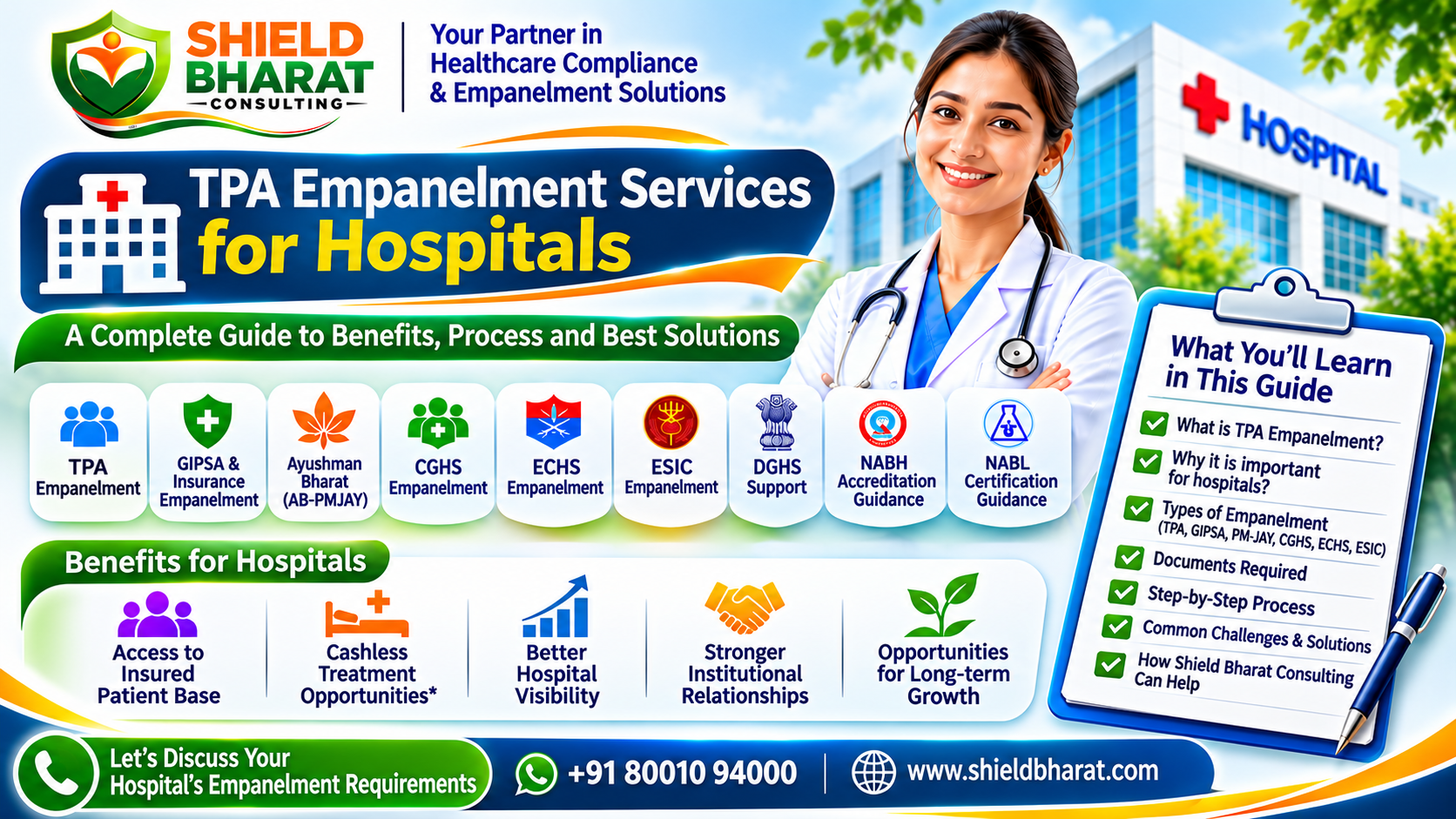
Introduction: Why Is TPA Empanelment Important for Hospitals?
The healthcare industry in India is evolving rapidly. With the growing awareness of health insurance, increasing medical expenses, and rising demand for quality healthcare services, patients are increasingly looking for hospitals that are connected with health insurance companies and Third Party Administrators (TPAs).
For hospitals, nursing homes, and multi-specialty healthcare facilities, TPA empanelment can be an important step towards developing relationships with insurance networks and making eligible cashless treatment facilities available to patients, subject to the applicable insurance policy and network arrangements.
Today, patients often consider insurance acceptance, hospital facilities, medical expertise, location, and treatment costs when selecting a healthcare provider. Being associated with relevant insurance and TPA networks can help hospitals serve eligible insured patients and strengthen their position in the healthcare ecosystem.
However, the TPA empanelment process involves more than submitting an application. Hospitals may need to fulfil specific eligibility criteria, maintain appropriate registrations and licences, prepare detailed documentation, provide infrastructure information, and comply with the requirements of individual insurance companies or network administrators.
This is where professional guidance can make the process more organized.
Shield Bharat Consulting provides hospital empanelment consulting, application guidance, documentation assistance, and healthcare compliance support to hospitals and nursing homes seeking to connect with TPAs and insurance networks.
This comprehensive guide explains what TPA empanelment is, why it matters, how hospitals can apply, what documents may be required, and how professional consulting support can help.
1. What Is TPA Empanelment?
TPA stands for Third Party Administrator. In the Indian health insurance ecosystem, a TPA is an organization licensed by the Insurance Regulatory and Development Authority of India (IRDAI) to provide specified health services to insurers under applicable regulations.
TPAs commonly assist with health insurance administration, including activities related to policyholder services, hospital network coordination, and cashless treatment processes, depending on their agreement with the insurer.
TPA empanelment refers to the process through which a hospital applies to become part of a relevant healthcare provider network associated with an insurer or TPA.
Once a hospital is approved and its network arrangement becomes effective, eligible insured patients may be able to access cashless treatment at that facility, subject to the insurer's policy conditions, authorization requirements, network agreement, and treatment eligibility.
It is important to understand that a TPA does not automatically provide insurance coverage or approve every treatment. The insurer remains responsible for insurance-related decisions under the policy, while the TPA performs the services assigned to it.
For hospitals, empanelment can create opportunities to establish relationships with healthcare financing and insurance organizations.
2. Why Is TPA Empanelment Important for Hospitals?
TPA empanelment can play an important role in the development of a hospital's insurance services and patient administration processes.
Many insured patients prefer to understand whether a hospital is part of their insurance network before choosing a healthcare facility. A hospital's participation in relevant networks can therefore be an important consideration for patients seeking eligible cashless treatment.
Here are some reasons why hospitals consider TPA empanelment.
A. Opportunities to Serve Insured Patients
Health insurance is an important part of healthcare financing in India. Patients with eligible health insurance policies may prefer hospitals that participate in their insurer's network.
TPA or insurer network empanelment can provide hospitals with opportunities to serve these patients, subject to network availability and policy conditions.
B. Access to Cashless Treatment Arrangements
One of the major reasons hospitals explore insurance empanelment is the possibility of offering cashless treatment to eligible patients.
Under an applicable cashless arrangement, the patient does not have to pay the entire approved hospital bill directly at the time of treatment. The insurer settles the admissible amount according to the policy and applicable authorization.
However, cashless treatment is not automatic. It depends on factors such as:
Whether the hospital is part of the relevant network.
Whether the patient's insurance policy is active.
Whether the proposed treatment is covered.
Whether applicable waiting periods or exclusions apply.
Whether pre-authorization is required and approved.
Whether the treatment and claim comply with policy conditions.
C. Stronger Relationships with Insurance Organizations
Empanelment provides an opportunity for hospitals to establish professional relationships with TPAs and insurance companies.
These relationships may help hospitals understand network requirements, administrative procedures, treatment authorization processes, and applicable billing guidelines.
D. Improved Hospital Visibility
Patients may search for hospitals through insurer and TPA network directories when looking for healthcare facilities.
Participation in relevant networks may improve a hospital's visibility among patients who are searching for providers associated with their insurance coverage.
E. Opportunities for Hospital Development
Insurance network participation may become one component of a hospital's broader business development strategy.
It can help hospitals explore new patient segments, build institutional relationships, and strengthen their healthcare service offerings.
However, empanelment alone does not guarantee increased patient numbers, revenue, or business growth. Results depend on hospital quality, location, medical specialties, pricing, network terms, and patient demand.
3. What Services Are Included in Hospital TPA Empanelment?
The requirements for TPA empanelment vary between organizations. Some insurers and TPAs may have their own application procedures, document formats, eligibility conditions, and network selection criteria.
A hospital may require assistance with several stages of the process.
TPA Empanelment Assistance
Guidance on identifying relevant TPAs, understanding their requirements, preparing applications, and organizing supporting documents.
GIPSA and Insurance Company Empanelment
Assistance with understanding applicable requirements and preparing documentation for insurance network applications.
GIPSA refers to the General Insurers' (Public Sector) Association of India. Hospitals may explore relevant network arrangements with participating insurers, subject to their respective policies and procedures.
Application Preparation
Application forms must be completed accurately. Information about the hospital, medical facilities, specialties, infrastructure, registrations, and management should be consistent with supporting documents.
Hospital Eligibility Assessment
Before submitting an application, hospitals should review their registrations, licences, infrastructure, medical staff credentials, facilities, and other requirements against the relevant organization's criteria.
Documentation Support
Hospitals may need to prepare and organize multiple documents, including statutory registrations, professional credentials, financial information, infrastructure details, and quality certifications.
Coordination and Query Handling
During application evaluation, the relevant organization may request additional documents, clarifications, or corrections.
Organized coordination can help hospitals respond to such queries efficiently.
Application Follow-up
Hospitals should maintain records of submitted applications, communication, pending requirements, and application status.
Professional follow-up can help keep the process organized, although the final evaluation timeline is controlled by the concerned organization.
4. Different Types of Hospital Empanelment in India
Hospitals can explore different empanelment opportunities depending on their specialties, infrastructure, location, registrations, and eligibility.
The following are some important categories.
A. TPA Empanelment
TPA-related network arrangements allow hospitals to explore participation in health insurance networks administered through relevant TPAs and insurers.
The exact process and contractual relationship depend on the insurer and TPA.
B. GIPSA Empanelment
GIPSA-related empanelment is relevant for hospitals interested in applicable network arrangements involving participating public-sector general insurance companies.
Hospitals should carefully review the current requirements, network guidelines, package rates, and other applicable conditions before applying.
C. Private Insurance Company Empanelment
Hospitals may apply to join the healthcare provider networks of private health and general insurance companies.
Each organization may have its own network selection criteria, documentation requirements, commercial terms, and approval process.
D. Ayushman Bharat – PM-JAY Empanelment
Ayushman Bharat Pradhan Mantri Jan Arogya Yojana (AB-PMJAY) is a government-sponsored health assurance scheme.
Eligible hospitals can apply for empanelment under the scheme through the applicable procedures and authorities.
Hospital eligibility, specialties, infrastructure, documentation, and verification requirements must be reviewed according to current scheme guidelines.
E. CGHS Empanelment
The Central Government Health Scheme (CGHS) provides healthcare facilities to eligible beneficiaries through its designated healthcare network.
Hospitals interested in serving eligible CGHS beneficiaries may explore the applicable empanelment process.
F. ECHS Empanelment
The Ex-Servicemen Contributory Health Scheme (ECHS) provides healthcare benefits to eligible ex-servicemen and their dependants through its authorized network.
Hospitals can review the applicable ECHS requirements to determine their eligibility.
G. ESIC Empanelment
The Employees' State Insurance Corporation (ESIC) provides social security and healthcare benefits to eligible insured persons and their dependants.
Hospitals may explore relevant arrangements based on applicable ESIC requirements and procedures.
H. DGHS-Related Hospital Empanelment
Hospitals may also explore applicable healthcare network and empanelment opportunities associated with the Directorate General of Health Services and relevant government healthcare arrangements.
Requirements depend on the specific programme or authority.
Important: These schemes and networks operate under different rules. Approval under one network does not automatically provide approval under another.
5. What Are the Documents Required for TPA Empanelment?
Documentation is one of the most important parts of the hospital empanelment process.
Incomplete, outdated, inconsistent, or incorrect documentation can result in queries, delays, or rejection.
The exact document checklist depends on the TPA or insurer. However, hospitals are commonly asked to provide documents from the following categories.
A. Hospital Registration Documents
Hospital or nursing home registration certificate.
Applicable establishment registration.
Ownership or legal entity documents.
PAN details of the organization.
GST registration, where applicable.
Registered office and hospital address proof.
Relevant local authority permissions.
B. Medical Staff Documents
Qualification certificates of doctors.
Medical registration details.
Consultant and specialist information.
Nursing staff details.
Medical superintendent or hospital administrator details.
Other professional credentials as required.
C. Infrastructure Documents
Hospital building details.
Bed capacity information.
Department and specialty details.
Operation theatre information.
ICU and emergency facilities.
Diagnostic and laboratory facilities.
Medical equipment details.
Photographs of hospital infrastructure, where requested.
D. Financial and Banking Documents
Bank account details.
Cancelled cheque.
Bank verification documents.
PAN details.
GST information, where applicable.
Financial statements or other documents if requested.
E. Quality and Compliance Documents
Applicable fire safety approvals.
Biomedical waste management authorization.
Pollution control permissions, where applicable.
Applicable clinical establishment or local authority permissions.
NABH accreditation or relevant quality certification, if required.
Other statutory approvals applicable to the facility.
F. Additional Documents
Depending on the organization, hospitals may also need to submit:
Hospital profile.
Specialty-wise service information.
Tariff details.
Package rate information.
Details of diagnostic services.
Emergency service information.
Insurance claim and billing contact details.
Declaration forms.
Agreements and undertakings.
Hospitals should not assume that the same checklist will work for every insurer or TPA. Always obtain the latest official requirements before preparing an application.
6. Step-by-Step TPA Empanelment Process for Hospitals
A systematic approach can help hospitals manage their empanelment applications more effectively.
Step 1: Identify Suitable TPAs and Insurance Companies
The first step is to identify organizations whose networks are relevant to the hospital's location, specialties, infrastructure, and patient requirements.
Hospitals should consider:
The organization's network presence.
Applicable specialties.
Hospital eligibility criteria.
Commercial and operational requirements.
Documentation requirements.
Application procedures.
Applying without checking eligibility can waste time and administrative resources.
Step 2: Assess Hospital Eligibility
Before starting the application, the hospital should review its current status.
This may include checking:
Hospital registration.
Required licences and permissions.
Bed capacity.
Medical staff credentials.
Infrastructure and equipment.
Specialties and services.
Quality and compliance requirements.
Any gaps should be identified and addressed where possible.
Step 3: Prepare the Hospital Profile
A well-organized hospital profile helps present the facility's capabilities clearly.
It should include relevant information about:
Hospital background.
Location and contact details.
Ownership and management.
Available specialties.
Bed capacity.
Doctors and medical staff.
Diagnostic and treatment facilities.
Emergency services.
Infrastructure and equipment.
Information should be accurate and supported by relevant records.
Step 4: Organize the Documentation
Collect the required documents and verify that they are current, legible, and consistent.
Create a checklist to track:
Available documents.
Pending documents.
Expiry dates.
Required corrections.
Submission status.
Step 5: Submit the Application
Once the hospital profile and documents are ready, submit the application through the relevant official channel.
Follow the organization's prescribed application format and submission procedure.
Retain copies of all submitted documents and acknowledgement details.
Step 6: Respond to Queries
The TPA or insurer may request clarification or additional information.
Hospitals should respond within the specified timelines and ensure that supporting documents address the query accurately.
Step 7: Evaluation and Verification
Depending on the organization's process, the hospital may undergo document verification, infrastructure assessment, physical inspection, or other evaluation.
The hospital should ensure that the information submitted in the application matches the actual facilities and available records.
Step 8: Review the Agreement and Network Terms
Before accepting empanelment, hospitals should carefully review the agreement.
Important matters include:
Applicable treatment packages.
Agreed rates and tariffs.
Billing procedures.
Pre-authorization requirements.
Claim submission timelines.
Medical documentation standards.
Audit provisions.
Payment terms.
Dispute resolution.
Termination and renewal conditions.
The hospital should understand the commercial and operational obligations before signing.
Step 9: Complete Network Onboarding
After approval, the hospital may need to complete onboarding activities, including sharing contact information, billing details, treatment package information, and operational communication details.
The hospital should confirm the effective date and scope of its network arrangement.
Step 10: Maintain Compliance
Empanelment is not the end of the process.
Hospitals must continue meeting applicable network, regulatory, clinical, documentation, and service requirements.
Changes in licences, management, infrastructure, bank details, or other important information should be communicated as required by the agreement.
7. Common Challenges Faced by Hospitals During TPA Empanelment
Although empanelment can create useful opportunities, hospitals may encounter several challenges during the application process.
Incomplete Documentation
Missing registration certificates, outdated licences, inconsistent addresses, and incomplete staff information can lead to additional queries.
Solution: Maintain a centralized document checklist and review all supporting documents before submission.
Understanding Different TPA Requirements
Different TPAs and insurers may have different application formats, eligibility conditions, and network policies.
Solution: Review the requirements of each organization separately rather than submitting identical applications without modification.
Hospital Infrastructure Gaps
A hospital may not meet certain infrastructure, equipment, specialty, or operational requirements.
Solution: Conduct an internal assessment before applying and identify areas that require improvement.
Delays in Application Communication
Applications may require additional information or verification. Delayed responses can affect progress.
Solution: Assign a responsible person to monitor communication and maintain a record of every query and response.
Understanding Commercial Terms
Hospitals may face difficulties understanding package rates, billing requirements, deductions, claim procedures, and payment conditions.
Solution: Review all commercial terms carefully and seek appropriate professional or legal advice before signing an agreement.
Maintaining Post-Empanelment Compliance
Hospitals must continue to follow applicable requirements even after approval.
Solution: Establish internal processes for documentation, billing, patient records, claim submission, and compliance monitoring.
8. Why Should Hospitals Consider Professional TPA Empanelment Consulting?
The empanelment process requires coordination between hospital management, administrative teams, medical professionals, finance departments, and external organizations.
Hospitals that do not have a dedicated empanelment team may find it challenging to manage all these activities.
Professional consulting support can help organize the process.
A hospital empanelment consultant may assist with:
Understanding applicable empanelment requirements.
Identifying relevant TPA and insurance networks.
Reviewing hospital eligibility.
Preparing the hospital profile.
Organizing application documents.
Identifying missing or inconsistent information.
Supporting application submission.
Coordinating responses to queries.
Tracking application progress.
Providing guidance on compliance documentation.
A consultant cannot replace the approval authority or guarantee acceptance. However, professional assistance can help hospitals prepare more systematically and manage administrative work more efficiently.
9. How Shield Bharat Consulting Helps Hospitals with TPA Empanelment
Shield Bharat Consulting is focused on helping hospitals, nursing homes, and healthcare providers understand and manage hospital empanelment and healthcare compliance requirements.
Our objective is to provide practical guidance and organized documentation support throughout the applicable application process.
Our Key Services
TPA Empanelment Assistance
Guidance and documentation support for hospitals seeking to apply for relevant TPA and insurer network arrangements.
GIPSA and Insurance Company Empanelment
Support in understanding applicable requirements and preparing documentation for relevant insurance network applications.
Government Healthcare Scheme Guidance
Assistance in understanding the applicable processes and documentation requirements for schemes and networks such as:
Ayushman Bharat (AB-PMJAY).
CGHS.
ECHS.
ESIC.
Relevant DGHS-related arrangements.
Hospital Documentation Support
Assistance in organizing hospital registration records, staff credentials, infrastructure details, statutory documents, and other application-related information.
NABH Accreditation Guidance
Guidance on understanding NABH accreditation requirements and preparing for applicable quality and compliance processes.
NABL Certification Guidance
Support in understanding relevant NABL certification requirements, particularly where laboratory quality standards and accreditation are applicable.
ROHINI Registration Assistance
Guidance on applicable ROHINI registration requirements for healthcare facilities.
Application Coordination and Follow-up
Support in organizing communication, tracking application status, and preparing responses to application-related queries.
Our approach focuses on understanding each hospital's requirements rather than treating every facility as identical.
10. What Should Hospitals Check Before Choosing a TPA Empanelment Consultant?
Selecting the right consulting partner is an important decision.
Before engaging any consultant, hospital management should consider the following points.
Experience and Domain Understanding
Choose a consultant who understands hospital operations, insurance networks, documentation, and healthcare compliance requirements.
Clear Scope of Services
Understand exactly what the consultant will provide.
Ask whether the service includes eligibility assessment, documentation preparation, application submission assistance, coordination, and follow-up.
Transparent Professional Fees
Discuss the consulting fees, payment schedule, additional expenses, and scope of work in advance.
Communication and Updates
The consultant should provide clear updates about pending documents, application status, queries, and next steps.
No False Approval Promises
Be cautious of anyone promising guaranteed empanelment or approval within a fixed period.
Final decisions belong to the relevant TPA, insurance company, government authority, or scheme administrator.
11. TPA Empanelment vs. Insurance Company Empanelment: What Is the Difference?
These terms are often used interchangeably, but the actual arrangement can differ.
TPA empanelment generally refers to a hospital joining a provider network associated with an insurer and administered or supported through a TPA arrangement.
Insurance company empanelment refers to a hospital entering into a network arrangement directly with an insurance company or through the applicable network administration process.
The insurer's network policy, contractual arrangement, and applicable regulations determine the exact responsibilities of each party.
Hospitals should always confirm:
Which organization is approving the hospital.
Which insurer's policyholders are eligible.
Whether the network arrangement is active.
Which treatments and specialties are covered.
What authorization and billing processes apply.
Where claims and queries should be submitted.
Understanding these differences helps hospitals manage patient communication and insurance administration more effectively.
12. Frequently Asked Questions About TPA Empanelment
Q1. What is TPA empanelment for hospitals?
TPA empanelment is the process through which a hospital applies to become part of a relevant healthcare provider network associated with a TPA or insurer. Approved network arrangements may allow eligible insured patients to access applicable cashless treatment facilities.
Q2. Why is TPA empanelment important?
It can help hospitals connect with insurance networks, serve eligible insured patients, develop institutional relationships, and explore opportunities for healthcare business development.
Q3. Which hospitals can apply for TPA empanelment?
Hospitals and nursing homes that meet the relevant TPA or insurer's eligibility requirements may apply. Requirements depend on infrastructure, registrations, medical specialties, staffing, and other criteria.
Q4. What documents are required for TPA empanelment?
Common documents include hospital registration certificates, licences, PAN details, banking information, doctor credentials, infrastructure details, specialty information, and applicable compliance documents. The final checklist varies by organization.
Q5. How long does TPA empanelment take?
There is no universal timeline. Processing depends on the TPA or insurer, document completeness, verification requirements, queries, and internal approval procedures.
Q6. Does TPA empanelment guarantee cashless treatment?
No. Cashless treatment depends on the patient's policy, hospital network status, treatment eligibility, authorization, and applicable insurer terms.
Q7. Can a nursing home apply for TPA empanelment?
A nursing home may apply if it meets the relevant organization's eligibility requirements. The applicable criteria should be checked before submitting an application.
Q8. What is GIPSA empanelment?
GIPSA refers to the General Insurers' (Public Sector) Association of India. GIPSA-related empanelment concerns applicable network arrangements involving participating public-sector general insurance companies.
Q9. Is NABH accreditation compulsory for every TPA empanelment?
Not necessarily. NABH accreditation requirements depend on the particular TPA, insurer, government scheme, or empanelment category. Hospitals should check the current applicable guidelines.
Q10. Can Shield Bharat Consulting help with TPA empanelment?
Shield Bharat Consulting provides professional guidance and documentation support for hospital TPA empanelment, insurance network applications, GIPSA-related processes, and healthcare compliance requirements.
Q11. Does Shield Bharat Consulting guarantee approval?
No. Approval depends on the hospital's eligibility, submitted documents, applicable criteria, and the decision of the relevant organization. Shield Bharat Consulting provides consulting and application support.
Q12. How can a hospital contact Shield Bharat Consulting?
Hospitals and nursing homes can contact Shield Bharat Consulting by phone, WhatsApp, or email to discuss their requirements and understand the available consulting support.
13. Conclusion: Build Stronger Healthcare Networks Through Professional Guidance
TPA empanelment can be an important part of a hospital's healthcare and business development strategy.
By connecting with relevant insurance networks, hospitals may create opportunities to serve eligible insured patients, strengthen institutional relationships, and improve their visibility among insurance policyholders.
However, the process requires careful planning, accurate documentation, an understanding of eligibility requirements, and continued compliance with applicable network conditions.
Hospitals should not treat empanelment as simply an application submission exercise. They should also evaluate contractual terms, treatment packages, billing processes, claim requirements, and operational responsibilities before joining any network.
With a systematic approach and appropriate professional guidance, hospitals can manage the empanelment process more effectively.
Shield Bharat Consulting supports hospitals, nursing homes, and healthcare providers with TPA empanelment guidance, GIPSA and insurance company empanelment assistance, government healthcare scheme guidance, hospital documentation, and compliance support.
If your hospital is planning to connect with TPAs and insurance companies, our team can help you understand the applicable requirements and prepare for the process.
Need Assistance with TPA Empanelment?
Connect with Shield Bharat Consulting to discuss your hospital's empanelment requirements.
Phone / WhatsApp: +91 80010 94000
Email: connect@shieldbharat.com
Website: https://shieldbharat.com/
Address: Moti Nagar, New Delhi – 110015
Shield Bharat Consulting
Your Partner in Healthcare Compliance & Empanelment Solutions.
Helping Hospitals and Healthcare Providers Become Better Prepared for Empanelment, Compliance, and Insurance Network Opportunities.
Disclaimer: This article is intended for general informational purposes and does not constitute legal, regulatory, medical, or insurance advice. TPA and insurance network requirements may change and vary between organizations. Hospitals should verify current requirements with the relevant TPA, insurer, or authority before applying. Empanelment, accreditation, cashless treatment, and claim approvals are subject to applicable eligibility criteria, contractual terms, policy conditions, and the decisions of the concerned organizations. Shield Bharat Consulting provides professional consulting and documentation support and does not guarantee approval.